Brienne of Tarth–Sansa Stark
A Feast for CrowsBrienne of Tarth–Sansa Stark is defined by a promise made in the aftermath of King Joffrey’s death. Brienne of Tarth undertakes to find and protect the missing Sansa Stark, not because Sansa is her sister by blood, but because Brienne has bound herself to the duties owed to the dead, to Lady Catelyn, and to Jaime Lannister. In a realm where roads, ports, castles, and loyalties have been broken by war, the search becomes an active form of guardianship: Brienne must create a path toward a girl who has no safe home to return to.
The Vow and Its Burden
Brienne’s immediate pledge was made to Jaime Lannister in King’s Landing. She promised that she would find the girl and keep her safe for the sake of Sansa’s mother and for Jaime himself. Brienne recognizes that such words are easy while deeds are hard, and she judges herself harshly for having lingered too long in the city and learned too little. Sansa had vanished on the night King Joffrey died, and anyone who knew where she had gone was refusing to speak to Brienne. The search therefore begins not with reliable information but with a vow that must survive uncertainty.
The promise also continues Brienne’s earlier obligation to Lady Catelyn. Brienne had sworn to bring back Catelyn’s daughters, but Arya Stark was believed to be dead, while the girl sent north to marry Roose Bolton’s bastard was a false Arya. That left Sansa as the only remaining daughter Brienne could still recover. Oathkeeper, the sword Jaime gave her and named, becomes the material emblem of this overlapping loyalty. The weapon does not simplify her duty; it makes the promise tangible and reminds her that the quest is meant to be fulfilled through action rather than honorable language alone.
Searching a Shattered Realm
Brienne assumes that Sansa has escaped King’s Landing because the gold cloaks would have found her had she remained there. Yet the alternatives are almost impossible to distinguish: Sansa might be in the next town, or on a ship bound as far away as Asshai. Brienne considers what a newly flowered maiden, alone, afraid, and in desperate danger, might do, but every answer is constrained by the destruction surrounding her. Sansa’s father has been beheaded before her eyes, her mother was murdered at the Twins, and Winterfell was sacked and burned, with its people killed. The girl has no father, mother, brothers, or secure stronghold to guide her home.
The ordinary routes are dangerous. The ironborn hold Moat Cailin across the Neck, and the Freys occupy the Twins after murdering Sansa’s brother and mother. Travel by sea is scarcely easier: the harbor at King’s Landing remains ruined, its river clogged with broken quays and burned or sunken galleys. Brienne questions people along the docks and learns that some trading ships are unloading in the bay while others continue north along the coast toward Duskendale, whose port is busier than ever. Geography thus becomes part of the relationship’s drama. Brienne is not merely looking for a person; she is calculating which fragments of a war-damaged world might still offer Sansa passage or concealment.
At Rosby, Brienne asks a grey-haired goodwife for a highborn maid of thirteen with blue eyes and auburn hair, possibly traveling with a portly knight or a fool. The blacksmith, the septon, a swineherd, a gardener, and other villagers have seen nothing. At the castle gates, two spearmen offer neither useful information nor dignity: one crudely implies that a girl traveling the roads would soon cease to be a maid, while the other asks a sexual question about Sansa’s appearance. Brienne leaves without help, having encountered the vulnerability that makes her search necessary as well as the vulgarity that makes the roads unsafe.
Her questioning continues beyond Rosby. Begging brothers, a young septon, silent sisters, oxcarts carrying grain and wool, a swineherd, and an old woman in a guarded litter all fail to identify the girl. A traveler tells Brienne that the road between her present position and Duskendale is safe enough, but that outlaws and broken men wait beyond it. Later, near Maidenpool, she again asks an old farmer whether he has seen her sister, calling Sansa a fair maid of thirteen. He has not, and Brienne thinks that no one has seen her, yet she continues asking. The repeated failure does not dissolve the mission; it turns persistence itself into its clearest action.
The Search as Protection
Brienne’s search is investigative, but its emotional force comes from the fact that Sansa is never treated as a neutral quarry. Brienne imagines her as alone and endangered, and she understands that capture would expose her to people who want to deliver her to the queen for profit or favor. The danger is therefore personal, political, and commercial at once. Sansa’s identity makes her valuable, while her youth and isolation make her vulnerable; Brienne’s task is to reach her before those two facts are exploited.
The landscape repeatedly measures the scale of the undertaking. Autumn leaves whirl across the road, and Brienne compares finding one lost girl in Westeros to finding one leaf in the wind. The image expresses the near-impossibility of the search, but it also clarifies why surrender would be a betrayal. Brienne briefly wonders whether Jaime has sent her on a cruel joke and whether Sansa may already be dead, hidden in an unmarked grave. She rejects that suspicion because she believes Jaime was sincere. The quest depends on trust even when evidence is absent: Jaime’s seriousness, Catelyn’s dying obligation, and Sansa’s precarious life all reinforce one another.
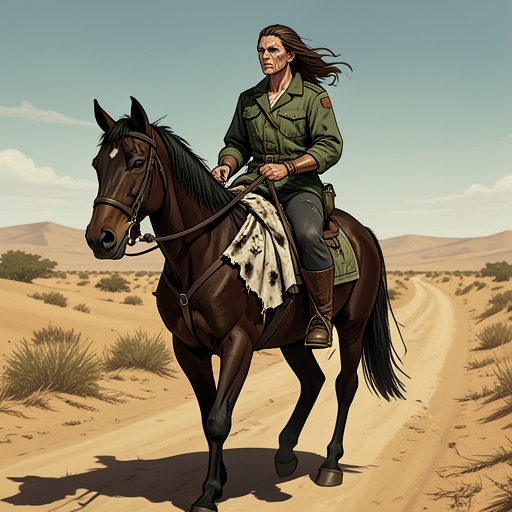
At the Old Stone Bridge, Brienne finally acts without waiting for the search to become easier. After her candle burns out and the inn falls silent, she gathers her possessions, leaves barefoot, puts on her boots in the darkness, saddles the bay mare Jaime gave her, and rides away without waking or confronting the knights who sheltered there. As the mare’s hooves ring over the old bridge and the trees close around her, Brienne renews the mission inwardly, promising that she will not rest until she finds Sansa and reassuring the absent girl that she should not be afraid. The scene converts the quest from an intention into a continuing discipline: Brienne chooses pursuit when no witness, reward, or immediate clue compels her to continue.
Memory, Identity, and the Stakes of Rescue
The full weight of the Brienne–Sansa mission emerges when Brienne recounts the path that brought her to this search. Her memories include the betrayals and betrothals surrounding her, Lord Renly’s favor and death, the rainbow cloak she valued, the mêlée at Bitterbridge, the journey with Lady Catelyn, the voyage down the Trident, and her duel with Jaime in the woods. They also include the Bloody Mummers, Jaime’s cry of “Sapphires,” Jaime in the bath at Harrenhal, Vargo Hoat’s blood when Brienne bit his ear, the bear pit, Jaime’s leap into the sand, and the long ride back to King’s Landing.
Within that chain of memories, Sansa’s name stands beside the vows, Oathkeeper, Duskendale, Maidenpool, Nimble Dick, Crackclaw, the Whispers, and the men Brienne has killed. The search is consequently not an isolated errand but the latest and most demanding expression of Brienne’s identity. Earlier experiences have given the promise its moral and physical cost: she has been betrayed, mocked, endangered, and forced to kill, yet those experiences do not make her abandon the obligation. Instead, they deepen her understanding of what it means for a vulnerable person to depend on someone else’s word.
Brienne finishes the confession by stating that she must find Sansa first because others are seeking the girl in order to capture and sell her to the queen. The objective is therefore competitive as well as protective. Brienne is not satisfied merely with the possibility that Sansa may survive somewhere; she must reach her before hostile forces do. Her final formulation is absolute: she has promised Jaime, Oathkeeper bears the name he gave it, and she must try to save Sansa or die in the attempt.
Narrative Significance
The relationship is deliberately asymmetrical. Sansa is absent from the search scenes, while Brienne carries Sansa’s description, danger, and imagined needs through the countryside. That absence prevents the bond from being sustained by reciprocal conversation. It is sustained instead by representation: Brienne repeatedly speaks Sansa into the notice of strangers, offering the girl’s age, beauty, blue eyes, and auburn hair as clues by which she might be recovered. Each unanswered question makes Sansa seem more elusive, but also makes Brienne’s role more unmistakable.
The quest contrasts the fragility of political protection with the endurance of personal obligation. Kings die, families are murdered, strongholds burn, roads become unsafe, and official searches fail, yet Brienne continues to act because she has chosen a promise as her governing principle. Her relationship with Sansa therefore gives the narrative a moral counterpoint to a world in which people are traded, hidden, betrayed, or used. Brienne cannot yet offer Sansa a home, a ship, or a certainty of safety. What she can offer is pursuit without rest: a commitment strong enough to cross ruined roads and endure the silence of everyone who cannot, or will not, tell her where the girl has gone.